Too many construction sites treat weekly toolbox talks as a compliance formality—something scribbled into a logbook before crews disperse to their tasks. But when done right, these brief sessions are not just about documentation. They’re frontline interventions that prevent injuries, reinforce accountability, and shape a culture where safety is second nature.
Yet across the industry, inconsistent delivery, poor topic selection, and lack of engagement turn what should be a powerful safety tool into a box-ticking exercise. The result? Near misses go unaddressed, workers tune out, and preventable incidents still happen.
This is not about reinventing the wheel. It’s about recommitting to a practice that works—when done with purpose.
Why Weekly Toolbox Talks Matter in Construction
Construction remains one of the most hazardous industries. According to OSHA, four fatalities occur every day on U.S. job sites. The “Fatal Four”—falls, struck-by incidents, electrocutions, and caught-in/between accidents—account for more than 60% of those deaths.
Weekly toolbox talks directly target these risks. They’re short (typically 10–15 minutes), focused discussions held at the job site with field crews. The goal is to identify hazards specific to the week’s work, reinforce safe behaviors, and open a channel for workers to voice concerns.
Beyond compliance, effective talks improve retention of safety knowledge. A study by the National Institute for Occupational Safety and Health (NIOSH) found that workers who participate in regular safety discussions are 50% more likely to report hazards and follow protocols.
But frequency alone isn’t enough. Relevance and engagement determine impact.
What Makes a Toolbox Talk Effective
A powerful toolbox talk isn’t a lecture. It’s a dialogue. It connects to real work being done this week—not generic safety tips pulled from a manual.
Here’s what separates effective talks from forgettable ones:
- Job-specific relevance: Talking about fall protection when crews are setting scaffolding that day makes the message immediate.
- Worker participation: Encourage questions, invite stories from the crew, and ask what they’ve seen on site.
- Visuals or demonstrations: Show a damaged harness, demonstrate proper ladder setup, or use a mock setup to illustrate risks.
- Clear takeaways: End with one or two actions—“Inspect lanyards before climbing,” or “Report damaged gloves to the foreman.”
- Documented follow-up: Note concerns raised and track action items. Workers need to see that feedback leads to change.
Real-World Example: Fall Protection Talk That Worked
A framing crew at a multi-family build was preparing to work at height on a new level. The foreman held a toolbox talk focused solely on fall protection:
- Reviewed the site’s fall protection plan
- Walked through proper harness inspection steps
- Asked each crew member to point out one hazard near the edge
- Demonstrated correct lanyard attachment using a mock anchor point
Afterward, two workers reported previously unnoticed anchor instability. The issue was fixed before work began. That talk didn’t just inform—it prevented a potential incident.
Common Mistakes That Undermine Toolbox Talks
Even experienced safety managers slip into patterns that weaken effectiveness. Avoid these recurring pitfalls:
1. Repeating the Same Topics Without Context Talking about PPE every week, without tying it to current tasks, breeds disengagement. If roofing is starting, focus on slip resistance, overhead hazards, and heat stress—not general glove safety.
2. One-Person Monologues
When the supervisor does all the talking, attention drops. Build in pauses. Ask, “Has anyone seen something unsafe related to trenching this week?” Let the crew lead part of the discussion.
3. Ignoring Site-Specific Risks Pulling a generic “electrical safety” talk from an online library misses the mark if the crew is doing lockout/tagout on a generator this week. Customize content.
4. Skipping Documentation or Follow-Up No record means no accountability. Worse: if a worker raises a hazard and nothing changes, trust erodes. Use a simple log—date, topic, attendees, concerns, actions.
5. Holding Talks Off-Site or Too Early A talk held in the office at 6 AM loses relevance by 9 AM on-site. Conduct them where the work happens, just before the task begins.
Structuring Your Weekly Toolbox Talk
Consistency in format increases clarity and reduces prep time. Use this proven framework:
1. Open with a Real Incident (1 min) Start with a brief story—local, recent, relevant. Example: “Last week in Dallas, a worker fell 12 feet from an unsecured ladder. Let’s talk how that could’ve been avoided.”
2. State the Topic & Scope (1 min) Be specific: “Today: ladder safety during HVAC installs on the 3rd floor.”
3. Review Hazards (3 min) List 2–3 key risks: overextension, unstable base, overhead lines.
4. Demonstrate Safe Practices (3 min) Show the 4-to-1 ladder angle rule. Have someone demonstrate three-point contact.
5. Engage the Crew (3 min) Ask: “What’s one time you’ve seen a ladder used unsafely?” or “Who’s had a close call with a wobbly setup?”
6. Assign Actions & Close (1 min) “Inspect every ladder before use. Report cracked rails immediately. Supervisor will check logs Friday.”
7. Document & Distribute Use a standard form. Share a copy with the safety officer. Post digital logs if using a platform.
Stick to this rhythm, and your crew will know what to expect—and participate.
Top 5 Tools for Managing Weekly Toolbox Talks
Digital tools can streamline creation, tracking, and compliance. Here are five reliable platforms used by construction firms:
| Tool | Key Features | Best For |
|---|---|---|
| SafetyCulture (iAuditor) | Template library, photo uploads, real-time reporting, analytics | Teams wanting deep customization and reporting |
| SiteDocs | Offline access, automated workflows, integration with SAP | Larger contractors managing complex safety programs |
| eCompliance | Mobile forms, incident linkage, dashboard alerts | Companies focused on audit readiness |
| Procore Safety | Built into project management, punch lists, training records | Firms already using Procore for operations |
| SmartWeld | Simple, low-cost, pre-built toolbox talk library | Small to mid-sized contractors needing fast setup |
Each platform reduces paperwork and ensures talks aren’t lost in binders. But no tool replaces a skilled facilitator. Use tech to support—not substitute—for human engagement.
Integrating Toolbox Talks Into Your Safety Program
Toolbox talks shouldn’t live in isolation. They’re most effective when connected to broader safety systems.
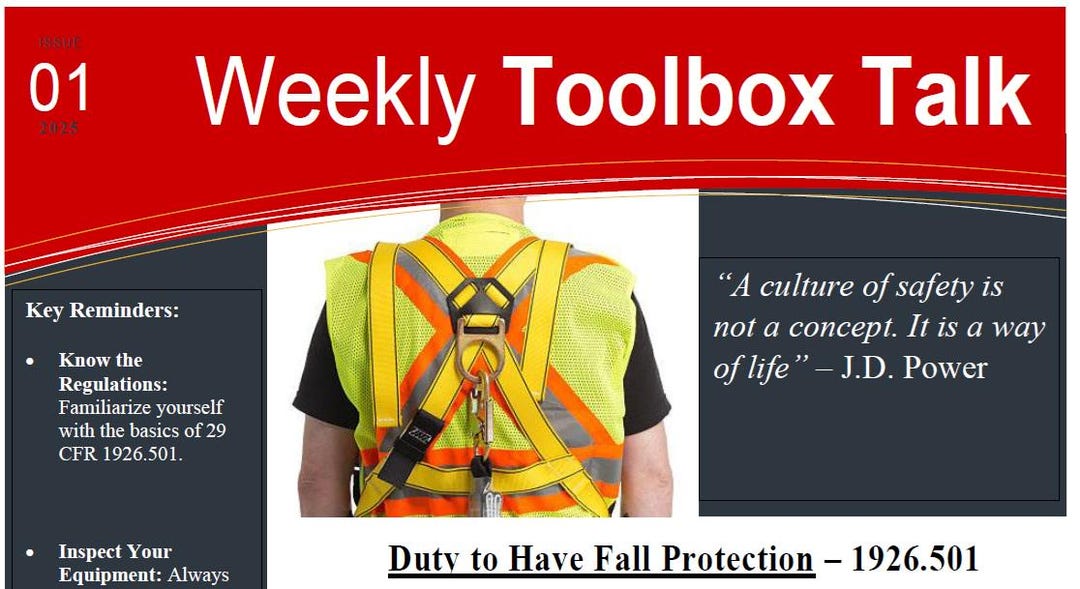
- Link to JSA (Job Safety Analysis): Use the week’s JSAs to shape talk topics. If a new excavation is planned, your talk should cover trenching hazards, soil types, and emergency procedures.
- Tie to Incident Reports: If a near miss occurs, address it in the next talk. Example: “Tuesday’s crane swing came too close to the scaffold. Let’s review swing radius protocols.”
- Align with Training Schedules: Reinforce recent training. After fall protection certification, follow up with weekly reinforcement talks.
- Involve Crew Leads: Train foremen to lead talks. Rotate facilitators to build ownership and leadership skills.
- Measure Impact: Track participation, action items closed, and trends in near-miss reporting. If talks are working, safety metrics improve.
One electrical contractor reduced recordable incidents by 40% in 18 months simply by integrating toolbox talks with daily huddles and monthly safety audits.
Making Toolbox Talks Sustainable
The biggest threat to consistency isn’t time—it’s fatigue. When talks feel repetitive, engagement drops.
Break the cycle with these strategies:
- Rotate topics monthly: Use a 12-month calendar. Example: January – Cold Stress, April – Excavation, August – Heat Illness.
- Invite crew submissions: Let workers suggest topics based on what they’re seeing. A laborer might flag damaged extension cords others overlook.
- Use real photos from site: Instead of stock images, show an actual ladder setup from your project—good or bad.
- Celebrate safety wins: Start a talk by recognizing a worker who reported a hazard. Reinforce positive behavior.
- Keep it short: Respect time. If the crew knows it’ll be over in 12 minutes, they’ll stay focused.
Closing: Turn Weekly Talks Into a Safety Advantage
Weekly toolbox talks are not optional extras. They’re essential maintenance for your job site’s safety engine.
When delivered with focus, relevance, and two-way communication, they do more than check a regulatory box. They build trust, uncover hidden risks, and create a shared responsibility for safety.
Don’t settle for going through the motions. Invest in preparation. Train your leads. Use tools wisely. And always tie the talk to the work happening right now.
Make your weekly toolbox talk the moment crews stop, think, and commit to going home safe.
FAQ
What should be included in a weekly toolbox talk? A clear topic, job-specific hazards, safe work practices, crew discussion, and documented action items. Keep it brief, focused, and participative.
How long should a toolbox talk last? Ideally 10–15 minutes. Long enough to cover key points, short enough to maintain attention.
Who should lead toolbox talks on a construction site? Supervisors, foremen, or safety officers. With training, experienced crew members can also facilitate.
Are toolbox talks required by OSHA? OSHA doesn’t mandate “toolbox talks” by name, but requires regular safety training and hazard communication—weekly talks are a recognized best practice for compliance.
Can toolbox talks reduce accident rates? Yes. Regular, relevant talks improve hazard awareness and safe behavior, directly contributing to lower incident rates.
Should toolbox talks be documented? Yes. Documentation proves compliance, tracks issues, and shows crew concerns are taken seriously.
How often should toolbox talks be held? Weekly is standard, but increase frequency during high-risk activities like demolition, crane lifts, or confined space work.
FAQ
What should you look for in Weekly Toolbox Talks for Construction: Stay Safe, Stay Compliant? Focus on relevance, practical value, and how well the solution matches real user intent.
Is Weekly Toolbox Talks for Construction: Stay Safe, Stay Compliant suitable for beginners? That depends on the workflow, but a clear step-by-step approach usually makes it easier to start.
How do you compare options around Weekly Toolbox Talks for Construction: Stay Safe, Stay Compliant? Compare features, trust signals, limitations, pricing, and ease of implementation.
What mistakes should you avoid? Avoid generic choices, weak validation, and decisions based only on marketing claims.
What is the next best step? Shortlist the most relevant options, validate them quickly, and refine from real-world results.


